Nuclear Welding 

Automated welding solutions for nuclear applications. 
Contact Us for Nuclear Welding Solutions
Liburdi Dimetrics provides advanced nuclear welding systems for critical applications where weld quality, process control, and documentation are essential. In welding for nuclear power, the welding system must do more than produce a great weld. It must deliver repeatable performance, support strict quality requirements, and provide operators with the tools needed to monitor and control the process in real time.
Across new build projects, modular fabrication, and plant upgrades, nuclear construction welding demands a high level of consistency and control. Nuclear piping and component welds are often performed under demanding conditions, including heavy wall sections, restricted access, tight tolerances, and project-specific code requirements. For these applications, automated and mechanized welding provides important advantages in consistency, traceability, and operator control. Liburdi Dimetrics systems are designed to support these requirements across a wide range of nuclear applications.
Welding For Nuclear Power

Welding for Nuclear Power

Common Applications

01.

Primary Loop Piping

Welding for nuclear power is most demanding in the primary loop, where weld quality has a direct impact on long-term system reliability. Welding of primary loop piping is one of the most critical steps in construction of nuclear power plants. As such, the primary coolant system welds are subjected to the most stringent quality standards. Liburdi Dimetrics systems are equipped with the tools necessary to achieve first time quality and mitigate weld defects.

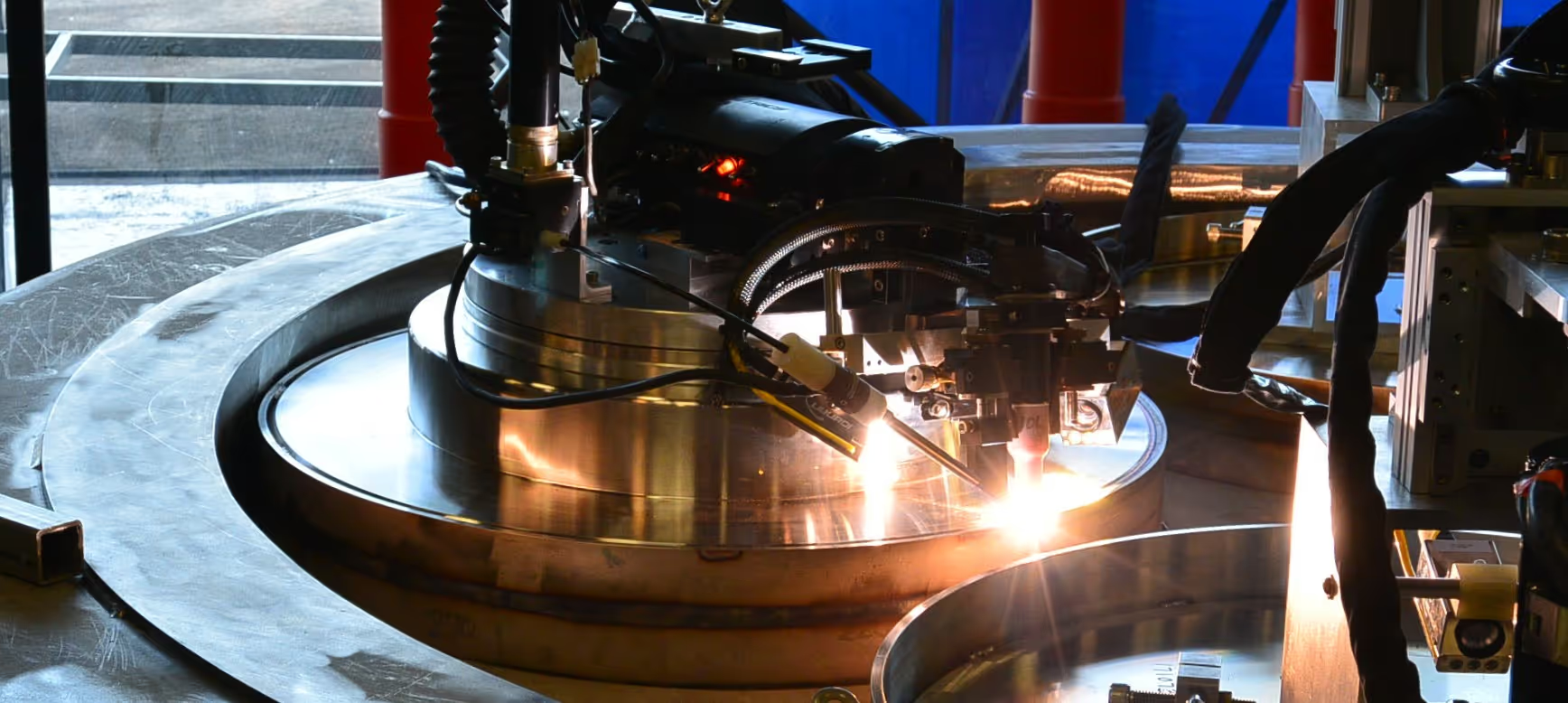
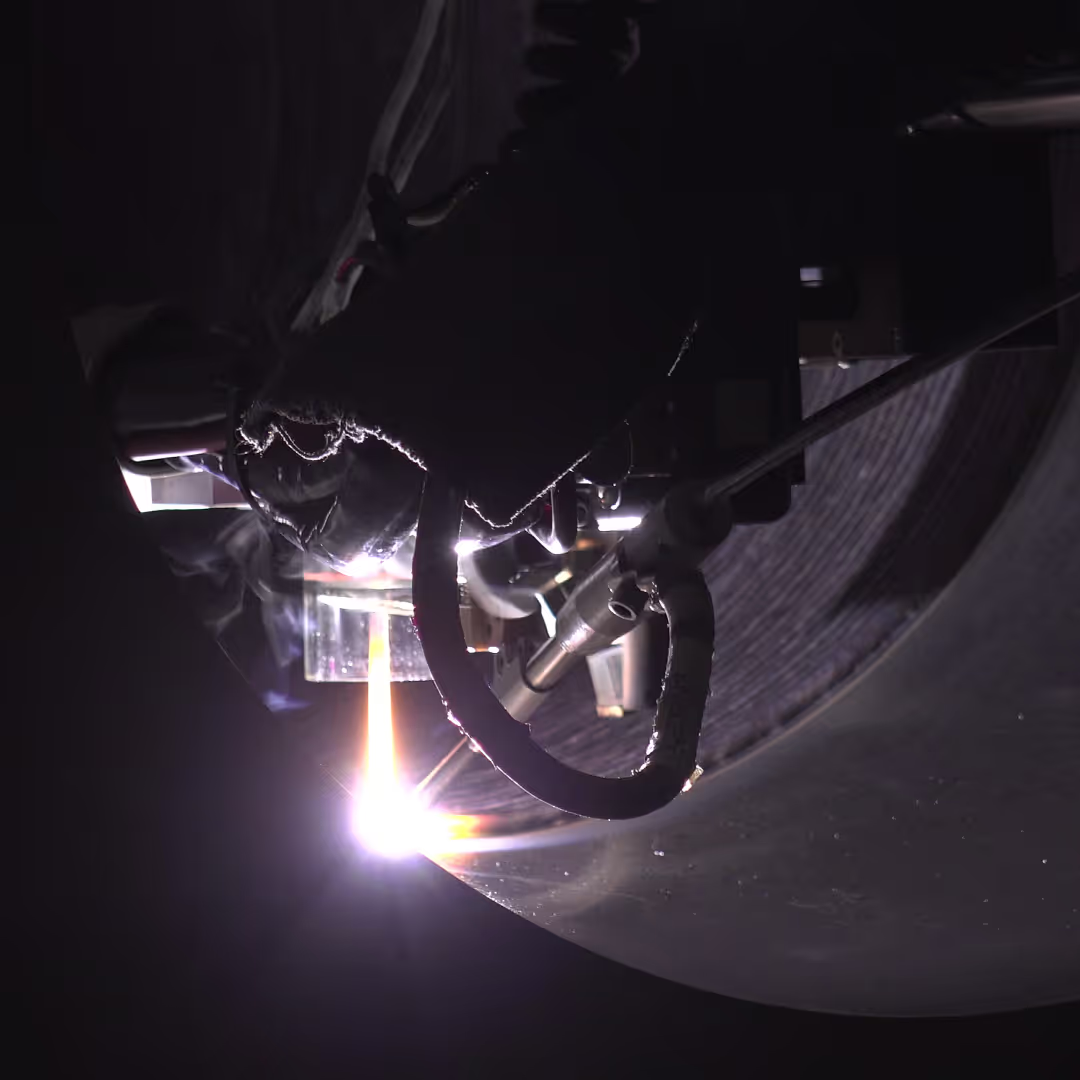
Given the thickness of primary loop pipes, nuclear pipe welding in these applications commonly uses Narrow Gap Gas Tungsten Arc Welding (NG GTAW). Weld joint design and process parameters are important not only to initial weld quality, but also to the long-term performance of the system. Of paramount importance is the ability to minimize weld distortion and residual stresses that can contribute to degradation mechanisms such as Primary Water Stress Corrosion Cracking (PWSCC).

Liburdi Dimetrics weld heads support all three NG GTAW torch architectures: open tungsten electrode, blade and blade with rotating tungsten. There are pros and cons to each design, but if distortion and residual stress control is the primary goal, we often recommend the open tungsten electrode architecture. The open tungsten electrode enables very narrow joint designs, which translates to less weld volume, lower distortion and lower residual stresses. The blade torch designs are necessary for weld joint depths in excess of 4 inches [100mm] and require lower shield gas flows. Rotating tungsten technology adds a layer of process forgiveness and typically allows for higher metal deposition rates. At Liburdi Dimetrics we work with our customers to select the best technology for each primary loop weld design.

02.

Secondary Loop Piping

Nuclear pipe welding is also critical in secondary loop systems, where large bore and heavy wall piping requires repeatable weld quality and stable process control. Automated welding improves consistency and helps maintain tighter control over arc position, travel, wire feed, and heat input throughout the weld sequence. These advantages are especially important in production environments where complete welding records and repeatable results are required across a large number of similar joints.

03.

Steam Generators and Heat Exchanger Components

Nuclear welding of steam generators and related heat exchanger components requires precision, repeatability, and a high degree of process stability. Depending on the application, these welds may involve tube to tubesheet, restricted access, or overlays with corrosion-resistant alloys. Liburdi Dimetrics systems provide the control needed to execute these welds with repeatable mechanical motion and stable process parameters.

04.

Reactor Building & Containment Structures

Reactor building and containment structure applications require welding systems that provide consistent control over heat input, particularly where weld quality and repeatability are critical to overall system integrity. Automated welding helps improve safety, productivity, and process consistency by giving operators greater control over the welding process and reducing variation from joint to joint. For critical components exposed to extreme heat, pressure, and demanding service conditions, this level of control supports more reliable weld performance and a higher standard of execution.

05.

Instrumentation and Small Bore Piping

Smaller diameter lines also require precise nuclear pipe welding, particularly where cleanliness, alignment, and heat input control are important. Liburdi Dimetrics systems for smaller diameter applications support orbital and mechanized GTAW processes that produce uniform welds while reducing dependence on operator technique.

06.

SMR and Modular Fabrication

Nuclear SMR welding plays an important role in the fabrication of piping assemblies, spools, and process modules for small modular reactor projects. In these environments, repeatability, documentation, and production efficiency are all critical. Nuclear SMR welding benefits from automated systems that can standardize the welding process across repeated assemblies while supporting the traceability requirements expected in nuclear fabrication. For shop-built modules and off-site manufacturing, nuclear welding must combine production efficiency with strict control of weld quality.

Nuclear Component Fabrication

Nuclear component fabrication often involves a combination of heavy-wall welds, restricted-access weld joints, and project-specific quality requirements. These applications may include safety-related piping, process modules, closure welds, and specialized fabricated components where welding consistency and full process documentation are essential.

Liburdi Dimetrics systems are designed to support this type of nuclear construction welding with programmable weld motion, integrated process control, and data logging capabilities. By combining the appropriate power source, welding head, torch configuration, and software package, the system can be configured to suit the joint design and production environment rather than forcing the application to fit a standard platform.
Nuclear SMR Welding

Why Automation is Critical in Nuclear

In nuclear welding, automation is not simply a productivity tool. It is a means of achieving greater consistency, tighter process control, and better documentation on welds where quality requirements are extremely high.
At the heart of the system is our FireView software, which displays camera images, weld parameters, and weld process controls on a single screen. This enables the operator to focus on the process and to respond quickly to any changes in weld conditions. FireView is also equipped with a data logger, and the reports generated by the software become part of the weld quality record.
Automated systems also improve control of critical process variables such as travel speed, arc voltage, oscillation, wire feed, and heat input. This is particularly important in nuclear construction welding, where distortion control, repeatability, and complete traceability are central to project success.
Liburdi Dimetrics Systems for Nuclear

Liburdi Dimetrics offers several products well suited to nuclear welding, nuclear pipe welding, and modular nuclear fabrication.

Our narrow groove welding systems are commonly configured around the GoldTrack VII platform with FireView software and the H Head for heavy wall pipe welding. For low-clearance or restricted-access applications, the J Head provides a compact solution with full welding functionality in a reduced package.

For smaller diameter pipe and tube applications, the M Series supports precise mechanized and orbital welding with the same focus on repeatability and process control. Where portability is important, the GT400 provides a field-ready power source suitable for demanding site applications, including nuclear construction welding and outage support.

For customers exploring more advanced digital process control, FirePilot can be integrated to support parameter development and real-time process optimization through digital communication with Liburdi Dimetrics welding systems.

Compliance, Traceability and Quality Assurance

Successful nuclear welding requires more than a sound weld. It requires documented evidence that the welding process was performed within the required parameters and in accordance with the applicable code, specification, and project quality requirements.

Liburdi Dimetrics systems support this need through integrated weld data logging, recorded parameter histories, and operator visibility of the welding process as it occurs. This documentation can form part of the overall weld quality package and support project requirements developed around standards such as ASME Section III and ASME Section IX, along with customer-specific quality programs and documentation procedures.

New Build, Refurbishment, and Long-Term Plant Support

In addition to new projects, Liburdi Dimetrics supports refurbishment welding for nuclear facilities where existing systems, piping, and critical components must be repaired, replaced, or upgraded. Refurbishment welding often presents different challenges than new build work, including tighter access, existing plant conditions, and the need to integrate with established procedures and quality programs. Automated and mechanized systems help bring greater consistency and control to these demanding applications.
Whether the requirement is nuclear construction welding for a new facility, nuclear SMR welding for modular fabrication, or refurbishment welding during plant upgrades, Liburdi Dimetrics provides systems designed for repeatable, well-documented welding performance.

Your Nuclear Welding Partner

Liburdi Dimetrics provides nuclear welding solutions for new build, modular fabrication, and refurbishment welding applications where weld quality and traceability are essential. Our systems are designed to give operators the control they need while helping fabricators and constructors meet demanding project requirements with repeatable, well-documented welding processes.

Contact us to discuss your nuclear welding application.
Contact Us for Nuclear Welding Solutions